
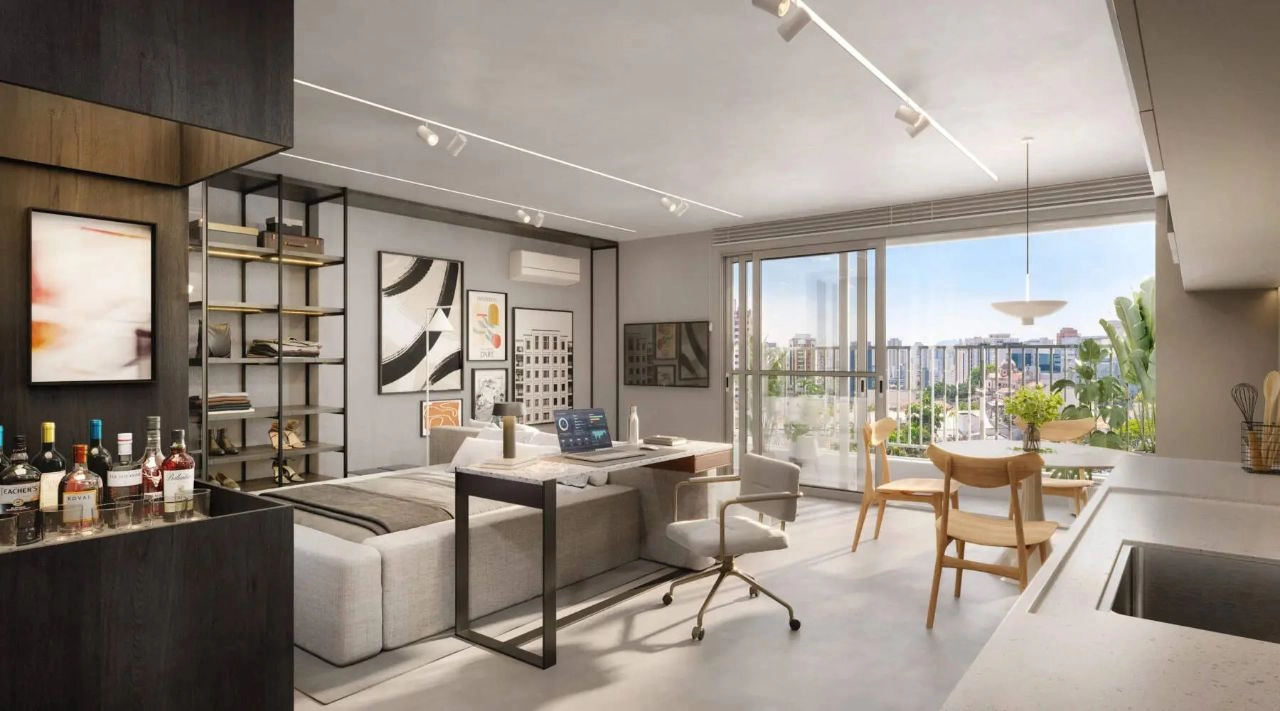
A compact unit is not a smaller apartment
A 90 m² apartment is purchased through comparison: square footage, number of bedrooms, parking spaces, price per square meter. A compact unit, between 30 and 45 m², is purchased through a different logic. The buyer is not asking "how many square meters am I getting?" but rather "which option best meets my needs?"
That changes everything. The compact unit does not compete only with other apartments. It competes with hotels, serviced flats, short-term rentals, and even fixed-income investments. Developers who treat the compact unit as "a traditional apartment shrunk down" tend to communicate what it lacks rather than what it solves.
A structural shift, not a trend
Compact units have moved beyond niche status. Studios and units up to 40 m² already account for a significant share of residential launches across the country, and one-bedroom properties are among those that have appreciated the most in recent indexes. Behind this lies a solid demographic foundation: more than 15 million Brazilians live alone, and short- and medium-stay rental platforms have multiplied demand for turnkey units.
In Goiás, this movement has arrived in full force. And that is precisely why the market has become more demanding: with greater supply, simply launching a compact unit is not enough. You need to launch the right compact unit, with the right brand, for the right audience.
One product, multiple audiences
Few property types speak to such diverse audiences. The same studio can be a young professional's first purchase, a practical residence for a childless couple, the first investment for someone moving out of fixed income, or a portfolio diversification tool for a seasoned investor.
This breadth is an advantage, but also the greatest pitfall. The most common mistake in compact unit launches is trying to speak to everyone with the same piece, using the same message. The result is generic communication that convinces no one.
The approach that works is defining a primary audience — one that sets the tone for the brand, naming, and positioning — and addressing secondary audiences in layers: specific arguments, specific messages, and specific media channels.
Emotion opens the door. Numbers close the sale.
With compact units, limited square footage tends to be perceived as "less." That is why value perception must be built before the sales center, before the launch event, and before conversion-focused media.
Communication works on two layers simultaneously. The emotional layer generates desire and belonging: atmosphere, lifestyle, identity. The rational layer supports the decision: projected yield, comparison with fixed-income returns, appreciation potential, location, and operating model. Numbers alone lose out to a stronger competing brand. Emotion alone breeds distrust, particularly among investors.
And there is a question every investor asks, even without saying it: five years from now, will this asset still be in demand among tenants, guests, and future buyers? That belief in future liquidity is born from the brand, not from the spreadsheet.
The building is the home
If the unit is smaller, the collective experience must be greater. In compact developments that sell well, the building carries the brand's promise. A rooftop with its own identity — one that becomes a destination and content in its own right, not just a generic pool on top. Coworking spaces, a standout fitness center, amenities distributed across multiple floors, seamless delivery solutions, ground-level services, automation, and professional rental management.
Each of these amenities must be chosen with consideration for which audience it activates and how it will be featured in the marketing. An amenity that never becomes a sales argument is a construction cost with no commercial return.
Product, brand, and launch as a single strategy
The greatest advantage lies in not separating the stages. Concept development, naming, branding, amenity mix, features, narrative, and commercial launch all perform better when each feeds into the next — without a loose handoff between those who conceived the product and those who will sell it.
When every touchpoint tells the same story — from art direction to the sales center, from the website to the sales team — the brand becomes greater than the sum of its units. This sustains the price point, reduces price sensitivity, and accelerates sales velocity.
Places's experience with compact units
At Places, compact units are a specialty built through hands-on experience. We have participated in product development, brand creation, launch, and lead generation for some of Goiás's most successful compact developments, including STAY, Smart Apart, Lux Oeste, and Alive Bueno, among others.
In each one, the same lesson repeats itself: the compact units that sell quickly are those where product and communication were developed together — with a clearly defined primary audience, amenities that become sales arguments, and a media strategy that generates desire before asking for contact information.
Across all property types, Places has participated in more than 300 launches and R$ 15 billion in launched GDV, across 17 states, with applied technical expertise in urban planning and market dynamics tailored to the Goiás market.
If your development company is planning a compact project, the best time to talk is before the design is finalized. That is when product decisions can still become brand advantages and sales velocity. Talk to Places.